
It's the technology you can't see that makes a high-performance meeting room
The best meeting rooms are the ones where no one has to think about the technology. There’s no connection issues, no searching for cables, and no delays while someone figures out how to start a video call. Meetings begin at the touch of a button, remote participants can see and hear everyone clearly, and the technology quietly adapts to whatever type of meeting is taking place.
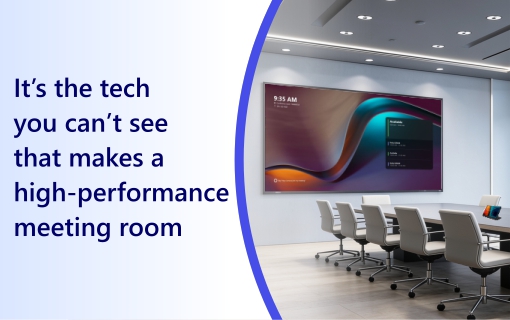
The expectation should be a consistent experience across every meeting space where the technology works seamlessly. In every space from break-out areas, boardroom, event, training spaces and meeting rooms there’s the same reliability, simplicity, and performance every time.
Designing effective ecosystems for seamless and reliable meeting experiences
A truly high-performance meeting room combines intuitive user experiences, high quality video conferencing, reliable networks, robust security, and thoughtful infrastructure. When these elements work together, meetings become more productive, collaboration improves, and the technology works silently in the background.
What makes a high-performance meeting room?
Successful meeting spaces share a number of characteristics. Meetings launch in seconds, participants both in the room and online can hear and be heard clearly, and high-quality video automatically focuses on speakers and presenters without manual intervention.
Behind the scenes, reliable network infrastructure keeps audio and video running smoothly, while careful cable management maintains a clean, professional environment free from clutter. Ongoing monitoring and maintenance ensure systems remain secure, updated, and operating at peak performance.
The most effective AV designs don't treat these elements as separate considerations. Instead, they are viewed as an interconnected ecosystem where user experience, networking, acoustics, security, and infrastructure all influence one another.
User experience always comes first
No matter how advanced the technology is, its success depends on how easily people can use it.
The primary objective should always be to make meetings effortless. Users should be able to walk into a room, tap a control panel, and start collaborating immediately. The experience should feel familiar regardless of which room they are using.
Modern meeting spaces increasingly rely on intelligent technologies such as automatic camera framing, speaker tracking, occupancy sensors, and wireless content sharing. These features reduce the need for manual adjustments and help meetings flow naturally.
Room layout also plays an important role. Displays need to be visible from every seat, cameras should be positioned at eye level wherever possible, and accessibility should be considered from the outset. Clear visual indicators showing microphone status, camera activity, and room availability help users feel confident and in control of the technology.
Building on a strong network foundation
Today's meeting rooms are no longer standalone AV systems. They are connected environments that rely heavily on a robust network infrastructure. Video conferencing platforms, digital signal processors, microphones, cameras, control systems, and digital signage all communicate across the network. Without the right architecture in place, even the best equipment can struggle to perform.
Dedicated AV network segments, quality of service (QoS) policies, and high-speed switching infrastructure help prioritise voice and video traffic and maintain a consistent user experience. Planning for bandwidth is also important, particularly in multi-room offices where Teams or Zoom meetings may be take place at the same time.
Security must be part of the design
As meeting technology becomes increasingly connected, it needs to be treated as part of a wider security strategy. Modern AV devices are network endpoints and should be protected accordingly. Secure equipment racks, restricted access to control systems, and lockable cabinets help safeguard physical infrastructure, while network-level protections such as authentication, segmentation, firewalls, and certificate-based communication help secure connected devices.
Good security also extends to device management. Regular firmware updates, strong administrative controls, and centralised monitoring reduce vulnerabilities, ensure compliance and future proof your technology investment. Read more about why you need proactive monitoring and maintenance here.
Acoustics – often the most overlooked element
When people complain about meeting room technology, it could be that poor acoustics are the real problem. If speech is unclear, meetings quickly become frustrating and unproductive. Creating an acoustically effective environment starts with controlling reverberation and reducing background noise.
Materials such as acoustic ceiling tiles, fabric wall panels, carpet tiles, and soft furnishings help absorb unwanted reflections and improve speech intelligibility. At the same time, it’s important to consider external noise sources such as HVAC systems, neighbouring rooms and traffic.
Microphone and loudspeaker selection has a major impact on room performance. Ceiling microphones, beamforming arrays, and intelligently positioned speakers help ensure everyone can hear and be heard clearly, regardless of where they are sitting. The result is a more natural conversation experience for both in-room and remote participants.
Why cable management matters
Cable management is often overlooked until something goes wrong. A well-organised infrastructure not only improves aesthetics but also enhances reliability, safety, and long-term serviceability. Hidden cables create cleaner, more professional spaces while reducing the risk of accidental damage or disconnections.
Good meeting room design includes dedicated cable pathways, under-table trays, floor boxes, equipment racks, and structured containment systems. Separating power, data, AV, and security cabling helps minimise interference while simplifying future maintenance.
Designing for future growth is equally important. Providing spare capacity within containment systems and equipment racks makes future upgrades far less disruptive and more cost-effective.
Bringing everything together
Consider a typical small meeting room designed for six to eight people. From the user's perspective, the experience is simple. They enter the room, tap a control panel, and begin their meeting. An intelligent camera automatically frames participants, while wireless content sharing allows presenters to connect instantly.
Behind the scenes, the room operates on a dedicated AV network with Teams and/or Zoom integration. Security controls protect connected devices and equipment is housed within secure enclosures. Acoustic treatments, beamforming microphones, and digital signal processing ensure conversations remain clear and natural. Structured cabling, floor boxes, and under-table cable management keep the space tidy while making future maintenance straightforward.
None of these individual elements alone create a high-performance meeting room. The real success comes from bringing them together into a unified, carefully designed ecosystem.
When user experience, networking, security, acoustics, and infrastructure are considered from the start, organisations create meeting spaces that support collaboration effortlessly and reliably. This empowers people to focus on the conversation rather than the technology.
Ensure every meeting runs seamlessly with proactive monitoring and maintenance.
Prevent meeting disrupton and downtime. With real-time monitoring and proactive issue resolution, our audiovisual / IT monitoring and maintenance service ensures all your devices stay connected, updated, and operational 24-7.
Copyright © 2026 Display Manager VC. All Rights Reserved.